
Five Mistakes to Avoid When Planning a Large-Scale Convention
Planning a convention is one of the most complex and high-stakes undertakings in the event industry. With thousands of attendees, multiple venues, high-profile stakeholders, and countless moving parts, even a small oversight can ripple into major logistical or reputational consequences.
A convention is not just another large event—it’s a living ecosystem that requires precision, collaboration, and foresight. From registration to closing remarks, every touchpoint shapes how attendees perceive your organization and how successfully your event meets its goals.
At Stratus Firm, we’ve managed conventions of every scale—including the Congressional Black Caucus Foundation’s Annual Legislative Conference (ALC), which brings over 16,000 guests, dignitaries, and security teams to Washington, D.C. each year. Our experience has shown us that the difference between a smooth, engaging convention and a chaotic one comes down to preparation—and avoiding a few critical pitfalls.
Here are the five biggest mistakes to avoid when planning a large-scale convention, along with proven strategies to ensure your next gathering is organized, efficient, and memorable.
Why Conventions Require Extra Precision
Conventions demand a higher level of planning than almost any other event type. While a gala or corporate summit may focus on a single room or audience, conventions often span multiple venues, days, and audience segments—each with unique logistics, staffing, and technology needs.
Scale amplifies complexity
The larger the event, the greater the margin for error. When your guest count hits the thousands, even a five-minute delay at registration can create long lines, strained staff, and frustrated attendees. Multiply that across catering, transportation, and programming, and the need for airtight systems becomes clear.
Multiple stakeholders, competing priorities
Large-scale conventions bring together sponsors, speakers, exhibitors, media, and attendees—all with different expectations. Without a clear structure, miscommunication and scope creep can quickly derail planning.
The stakes are higher
A convention is a reflection of your organization’s professionalism and brand. Mistakes aren’t just inconvenient—they can affect credibility, funding, and long-term partnerships.
That’s why precision isn’t optional; it’s essential. Let’s explore the five most common mistakes that can undermine even the best-laid plans.
Mistake 1: Skipping a Comprehensive Needs Assessment
The first and most damaging mistake in planning a convention is diving in without a proper needs assessment. Too often, organizers rush into logistics before defining purpose, audience, and success metrics.
The problem
Without a discovery phase, your event team may make assumptions about goals or guest expectations—leading to misaligned programming, bloated budgets, and missed opportunities.
You might end up:
Designing programming that doesn’t align with attendee needs.
Overinvesting in areas that don’t drive ROI.
Setting vague or unrealistic success criteria.
The solution
Start every project with a comprehensive event needs assessment—a structured discovery process that clarifies the “why” before the “how.” Ask:
What are our primary objectives (education, networking, fundraising, advocacy)?
Who are our key audiences and what do they value most?
What metrics define success—registrations, satisfaction, media coverage, or revenue?
At Stratus Firm, we use a detailed intake process that goes beyond checklists to uncover strategic priorities and stakeholder expectations. This front-end clarity prevents costly midstream changes and ensures that every decision supports your goals.
Pro Tip: Document and circulate the assessment results among all decision-makers. Alignment at the start avoids friction later.
Mistake 2: Underestimating Logistics and Flow
Logistics are the backbone of any large-scale convention—and the most common source of headaches when things go wrong. From registration queues to signage placement, every logistical detail impacts the attendee experience.
The problem
When logistics are underestimated, bottlenecks and confusion follow. Typical pain points include:
Long lines at check-in or badge pickup.
Poorly marked areas, leading to lost attendees.
Traffic jams in high-density zones.
Insufficient staff coverage or training.
Delays in setup, load-in, or transitions between sessions.
In large venues—especially convention centers or multi-hotel setups—poor flow can affect accessibility, safety, and overall satisfaction.
The solution
Plan your logistics like a military operation: map every movement, checkpoint, and timing detail. Key steps include:
Build detailed floorplans for each venue area, including attendee routes and emergency exits.
Create staffing matrices that define who manages each zone and what backup coverage exists.
Develop wayfinding systems (digital and physical) to guide guests effortlessly.
Coordinate load-in schedules with vendors, ensuring no overlap or downtime.
Example: CBCF Annual Legislative Conference
At the Congressional Black Caucus Foundation’s ALC, Stratus Firm oversees guest flow for more than 16,000 attendees, hundreds of exhibitors, and government officials—all under strict security protocols. Through layered credentialing, timed arrivals, and coordinated venue maps, we maintain order and comfort without compromising safety.
Pro Tip: Always conduct on-site walkthroughs before the event. Seeing the space in motion helps anticipate real-world flow challenges that floorplans can’t reveal.
Mistake 3: Failing to Engage Attendees Beyond Sessions
Panels and keynotes may be the core of your program—but they can’t be the only thing your attendees remember. When conventions focus solely on sessions, engagement and energy can quickly decline.
The problem
Passive learning leads to passive participation. If attendees spend three days sitting in back-to-back lectures, fatigue sets in—and networking, brand impressions, and sponsor ROI all suffer.
The solution
Transform your convention from a schedule into an experience. Integrate moments that surprise, delight, and connect:
Interactive lounges for informal networking or sponsor activations.
Experience zones where attendees can engage with content hands-on.
Wellness spaces with quiet seating, hydration stations, or guided breaks.
Gamified challenges (via event apps) that encourage exploration and reward participation.
Example: Stratus-Designed Conventions
At Stratus, we design conventions as ecosystems—not just programs. For instance, during large-scale leadership gatherings, we’ve built sponsor-branded lounges, hosted fireside conversations, and curated pop-up experiences that connect back to the event’s purpose. These design elements keep guests engaged and reinforce brand storytelling between sessions.
Pro Tip: Engagement doesn’t have to be expensive—it just needs intention. Ask, “What will guests talk about on their way home?” and design around that answer.
Mistake 4: Ignoring Technology and Hybrid Readiness
Technology is no longer an accessory—it’s infrastructure. From registration systems to hybrid streaming, the right tech ensures both accessibility and resilience.
The problem
Organizers who overlook technology risk alienating attendees or facing catastrophic technical failures. Common issues include:
Poor Wi-Fi coverage or bandwidth drops.
Outdated AV systems that are incompatible with presentation formats.
Lack of redundancy (no backup feeds or power).
Missing virtual participation options, limiting reach.
The solution
Treat technology as a strategic investment, not a budget line item. Build redundancy and innovation into your convention from day one:
Event platforms and apps: Simplify registration, agendas, and networking.
AV planning: Conduct full technical rehearsals and run backup feeds for critical sessions.
Hybrid infrastructure: Offer livestreams or recordings for remote audiences and accessibility.
Data integration: Capture attendee behavior and engagement to inform future events.
Example: Hybrid Conventions in Action
In recent years, Stratus has helped clients extend their conventions to global audiences through hybrid production—simultaneously broadcasting live sessions while integrating virtual Q&A and polling. This not only expands reach but also enhances inclusivity for international or mobility-limited participants.
Pro Tip: Always partner with tech vendors experienced in conventions, not just meetings. Scale changes everything—from rigging and fiber runs to real-time support.
Mistake 5: Overlooking Communication and Stakeholder Alignment
Even the most brilliant plans can unravel without clear communication. With dozens of vendors, departments, and volunteers involved, alignment is your most valuable resource.
The problem
Inconsistent updates, last-minute changes, or unclear roles lead to breakdowns that guests will feel immediately. Misaligned teams can create duplicated efforts, scheduling gaps, and safety risks.
The solution
Establish a communication hierarchy and cadence early in the process:
Centralized project management tools (like Asana or Monday.com) to track tasks and deadlines.
Daily briefings during the convention for department heads.
Unified contact sheets and escalation protocols for real-time issues.
Volunteer training sessions to standardize guest interactions and ensure consistency.
Example: Multi-Vendor Coordination at Scale
For large-scale conventions, Stratus coordinates multiple vendors—production, security, catering, transportation, and more—under one unified command structure. Daily run-of-show updates, visual site maps, and “war room” coordination ensure no team operates in isolation.
Pro Tip: Communicate early, clearly, and often. Overcommunication beats miscommunication every time.
How to Get It Right: Lessons from Experienced Producers
Avoiding mistakes is only part of the equation. To truly master convention planning best practices, adopt a producer’s mindset—one that blends creativity with control.
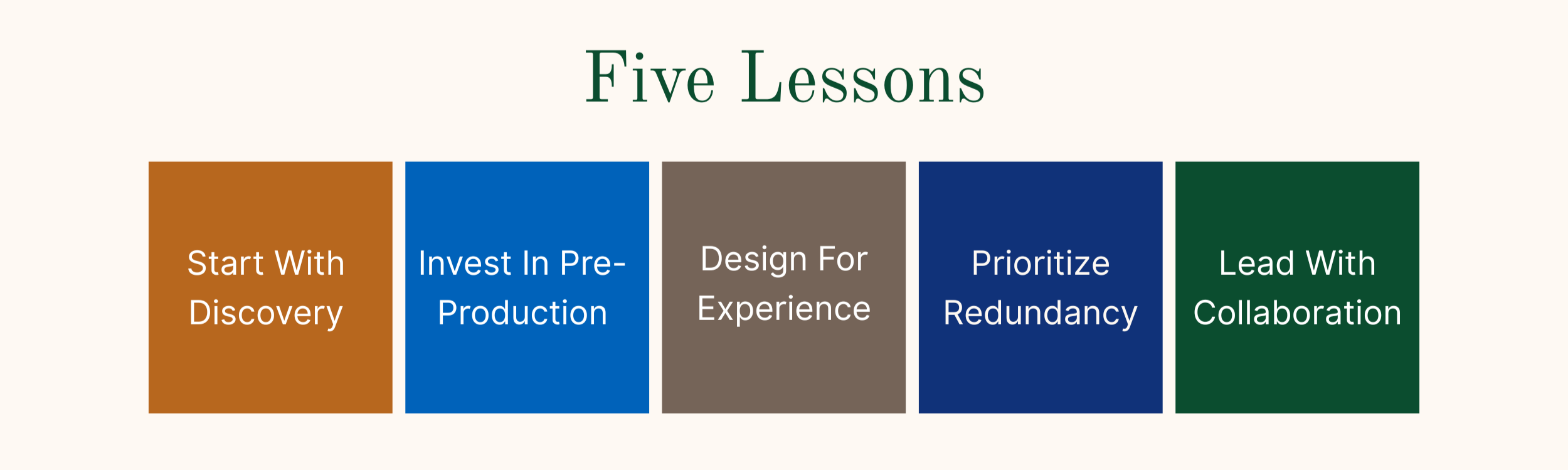
1. Start with Discovery
Use a formal needs assessment to clarify purpose, audience, and metrics. Every decision should trace back to these insights.
2. Invest in Pre-Production
Detailed run-of-show documents, floorplans, and staffing plans are your blueprint. The more comprehensive your pre-production, the smoother your execution.
3. Design for Experience
Think beyond logistics. Use lighting, sound, and storytelling to create moments of connection that guests will remember.
4. Prioritize Redundancy
For every essential system—AV, Wi-Fi, transportation—build in backups. In a large convention, “Plan B” is not optional.
5. Lead with Collaboration
Establish a culture of transparency and respect among partners. A cohesive team can overcome challenges that isolated teams cannot.
Setting Your Convention Up for Success
A successful convention doesn’t happen by luck—it’s the result of discipline, creativity, and coordination. Avoiding the five mistakes outlined above will help you build an event that operates seamlessly, delights attendees, and achieves measurable impact.
To recap:
Don’t skip your needs assessment—clarity at the start prevents chaos later.
Plan logistics down to the minute—the attendee experience is built on flow.
Engage attendees beyond sessions—create spaces for connection and discovery.
Integrate technology and hybrid options—expand your reach and resilience.
Communicate relentlessly—alignment drives excellence.
At Stratus Firm, we specialize in managing conventions that demand scale, precision, and storytelling. From multi-venue logistics to high-security coordination, our team delivers flawless execution with creativity at its core.
Ready to elevate your next convention?
Contact Stratus Firm to learn how our team can help you plan a large-scale convention that runs seamlessly and leaves a lasting impression.
-
Conventions operate like multi-day ecosystems with thousands of attendees, multiple venues, layered stakeholders, and dozens of vendors. Unlike a gala or single-room summit, conventions require synchronized logistics across registration, security, programming, transportation, technology, and attendee flow. This scale amplifies the margin for error, which is why precision and pre-production are essential for success.
-
A needs assessment is the discovery phase that clarifies your convention’s purpose, audience, goals, and success metrics before any logistics begin. Skipping this step leads to misaligned programming, inflated budgets, and unclear priorities. A strong assessment ensures every decision—from agenda design to sponsorship strategy—supports your organizational goals and attendee expectations.
-
Flow issues are one of the biggest pain points at conventions. To avoid bottlenecks and confusion, organizers should create detailed floorplans, map attendee routes, plan credentialing and staffing zones, schedule staggered arrivals, and install clear wayfinding systems. On-site walkthroughs and coordination with venue, security, and production partners allow you to test real-world movement before thousands of attendees arrive.
-
Engagement thrives when conventions move beyond back-to-back panels. Successful strategies include interactive lounges, sponsor activations, pop-up experiences, wellness spaces, hands-on learning zones, and gamified challenges through event apps. These intentional touchpoints energize attendees, promote networking, and create memorable moments that reinforce your brand and program themes.
-
Large conventions rely on clear, consistent communication. Organizers should establish a central project management platform, provide unified contact sheets, run daily department briefings, train volunteers thoroughly, and create escalation pathways for real-time issue resolution. Overcommunication is always better than missed communication—especially when working with multiple vendors, security teams, and program partners.