
How to Plan a Product Launch That Drives Buzz and Sales
A great product deserves a great debut. Yet even strong products can stumble if the launch is treated like a single press push or a pretty party. The stakes are high: a product launch can accelerate adoption, galvanize your community, and open new markets—or it can fizzle and force an uphill battle for attention.
A modern launch isn’t just about introducing a product. It’s about generating excitement that translates into measurable outcomes: qualified leads, revenue, brand affinity, media coverage, and sustained momentum. With the right strategy—rooted in clarity, experience design, and channel integration—your launch can build buzz, strengthen brand equity, and drive sales long after the event wraps up.
Why Product Launches Matter More Than Ever
Markets are crowded. Attention is scarce. Differentiation isn’t just a marketing nicety; it’s a survival tactic. A launch is one of the rare moments when you can legitimately command outsized attention—if you design it as a brand-building moment rather than a routine announcement.
A well-executed launch does four things simultaneously:
Signals significance. It tells your audience and the market that something meaningful has arrived—and why it matters now.
Coordinates channels. PR, paid media, social, email, partnerships, and events align to create a surround-sound effect.
Creates shared memory. A compelling experience becomes a story your audience repeats—amplifying reach organically.
Drives outcomes. From preorders to pipeline, the launch moment becomes the tip of a sustained demand-generation spear.
Think beyond the day-of moment. The launch is the opening chapter of your product story, not the epilogue to development.
Next up, the steps you need to follow
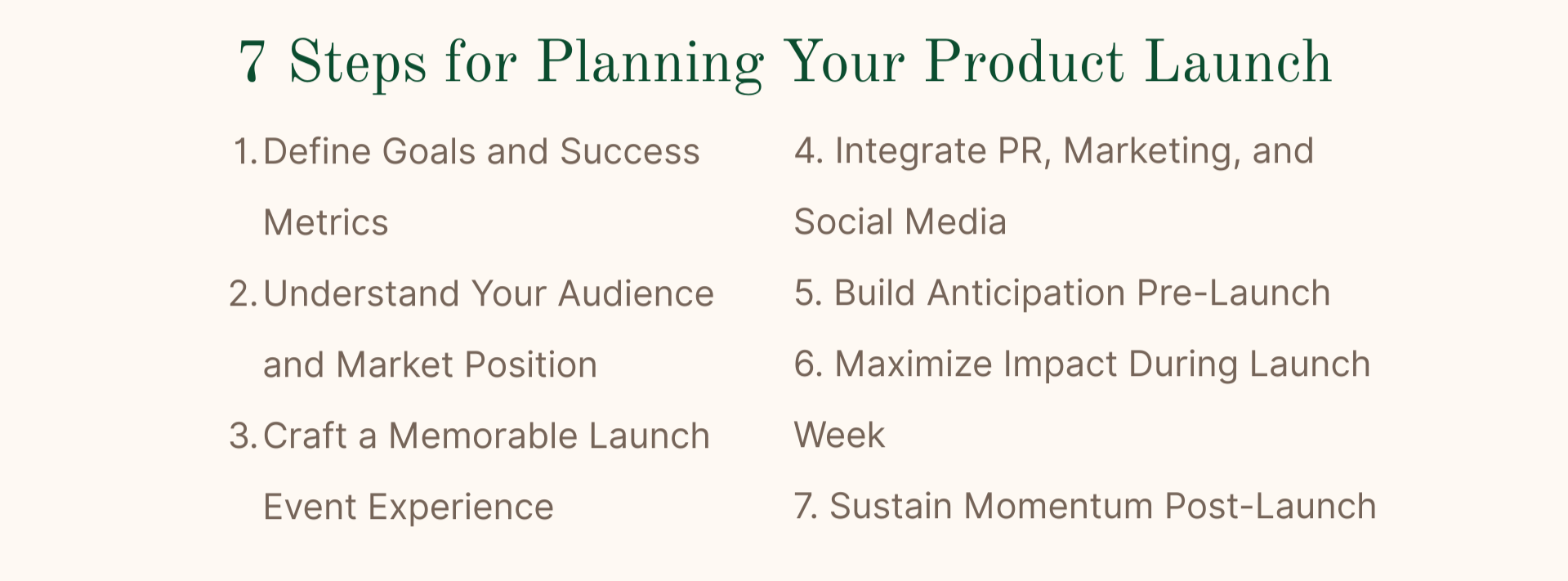
Step 1 — Define Goals and Success Metrics
Before you choose a venue or craft a headline, decide what success looks like. Remember that “Make a splash” isn’t a strategy. Clear goals shape creative choices, channel investment, and what you measure in the weeks and months that follow.
Set measurable objectives
Revenue: Preorders, launch-week sales, average order value, renewal/upgrade rates.
Pipeline (B2B): Marketing-qualified leads (MQLs), sales-accepted leads (SALs), demo requests, win rates.
Reach: Impressions, share of voice, press pickups, influencer mentions, keyword rankings.
Engagement: Event RSVPs/attendance, livestream watch time, content downloads, social saves/shares.
Brand: Lift in awareness or consideration, NPS among attendees, qualitative sentiment.
Align with business objectives
Tie launch metrics to quarterly and annual targets. If your company’s North Star is net revenue retention, for instance, weight your goals toward expansion campaigns, customer enablement content, and VIP previews for existing accounts.
Avoid “launching for the sake of launching”
If you can’t define who this is for, what they’ll do, and how you’ll know, pause. Refine your goals and reposition your launch until every tactic ladders back to measurable outcomes.
Step 2 — Understand Your Audience and Market Position
A launch succeeds when it resonates—emotionally and practically—with the people who matter most.
Segment your audience
Current customers: Need clarity on the value of upgrading or adopting add-ons.
Prospective buyers: Need proof, credibility, and urgency.
Media & analysts: Need a narrative, access to spokespeople, and usable assets.
Influencers & advocates: Need a personal reason to care—and something worth sharing.
Internal teams: Need enablement to evangelize the product consistently.
Tailor the message
For each segment, answer: What problem does this solve? Why is our approach different? Why now? Build short, modular messaging blocks (headline, value proof, feature-benefit, call to action) that can be used across PR, web, sales decks, and social media—ensuring consistency without sounding canned.
Map the competitive landscape
Identify how competitors frame similar capabilities. Your positioning should own a distinct idea—speed, simplicity, status, security, sustainability, or something uniquely yours. Let that positioning inform both the story and the experience you design.
Step 3 — Craft a Memorable Launch Event Experience
The launch event—physical, digital, or hybrid—should be the emotional engine of your campaign. It’s where your product’s story becomes an experience people feel, remember, and retell.
Make the event the centerpiece of a journey
A compelling event is not décor—it’s experiential storytelling. Design an arc:
Arrival & Anticipation: A reveal wall, a sonic cue, or a tactile invitation sets tone.
Immersion & Proof: Live demos, hands-on zones, guided stations, or AR overlays make benefits tangible.
Peak Moment: The reveal—projection mapping, kinetic lighting, or a choreographed unveiling—delivers an emotional crescendo that aligns to your message.
Participation & Shareability: Photo vignettes, creator zones, and interactive prompts invite content creation.
Resolution & Conversion: Clear calls to action—preorder kiosks, QR flows, promo codes—turn excitement into outcomes.
Curate multi-sensory design
Use lighting, soundscapes, textures, and scent to underscore the narrative. Align culinary elements with brand cues (a signature cocktail or tasting station that nods to the product’s origin). When the senses harmonize, the product feels inevitable—of course it exists.
Choose the right venue
Select a venue that enhances the story: an industrial space for rugged innovation, a gallery for design-forward products, a theater for dramatic reveals. Consider load-in realities, rigging, connectivity, and audience flow—magic requires physics.
The Stratus role
Stratus Firm designs launch moments that do more than “look cool.” We design journeys that move people from awareness to advocacy—choreographing creative, technical production, and guest experience so your message lands with precision and power.
Step 4 — Integrate PR, Marketing, and Social Media
Peak impact happens when every channel amplifies the same narrative.
Public relations
Embargoed briefings with select journalists and creators build informed coverage.
Press kits with concise messaging, product specs, media-ready visuals, and b-roll increase pickup.
Executive access (Q&As, office hours, or small-group briefings) deepens relationships.
Paid & owned marketing
Paid media: Retarget high-intent audiences; flight creative around the reveal and again around social proof.
Email: Segment lists (customers vs. prospects) and build progressive sequences: save-the-date → teaser → RSVP/CTA → “what to expect” → post-event offers.
Web & SEO: Launch a dedicated hub with FAQs, feature deep-dives, and demo booking.
Social media
Content ladder: Teasers → countdowns → behind-the-scenes → live moments → user-generated recaps → social proof.
Creator partnerships: Give early access to credible voices in your niche. Provide guardrails and assets, then let their personality shine.
Real-time engagement: Live Q&A, polls, and duets/stitches extend reach and participation.
When PR and marketing move in lockstep with event production, the launch feels ubiquitous—not repetitive.
Step 5 — Build Anticipation Pre-Launch
Hype isn’t an accident; it’s a sequence.
Tease the promise, not the product
Release silhouette images, macro shots, or cryptic taglines that hint at the benefit: faster mornings, fearless work, future-proof security. Curiosity fuels conversation.
Stage-gated access
Offer VIP previews for customers and partners, beta access for power users, or creator first looks under embargo. Scarcity signals importance and rewards your community.
Orchestrate your countdown
T–30 to T–14: High-level teasers, save-the-dates, and press outreach.
T–13 to T–7: Feature hints, influencer seeding, registration push, landing page SEO.
T–6 to T–1: Behind-the-scenes content, executive soundbites, social proof from beta testers.
T–0: Reveal, event, livestream.
T+1 to T+14: Recaps, press roundups, case studies, “what’s next.”
Keep messaging consistent
Use a single narrative spine—headline, value pillar, proof points—so every touchpoint reinforces the same idea.
Step 6 — Maximize Impact During Launch Week
This is your moment to own the conversation.
Create a “moment” people can’t ignore
Pair the reveal with a visual or emotional hook: a kinetic stage sequence, a surprise collab, a bold art installation. If it’s worth talking about, it’s worth sharing.
Expand reach with hybrid tactics
Livestream keynotes and demos. Offer virtual press rooms and real-time asset drops. Build interactive microsites that let remote viewers “handle” the product through 3D models, AR try-ons, or configurators.
Harness user-generated content (UGC)
Seed shareable moments and provide simple prompts: “Show us your first reaction,” “What problem will this solve for you?” Aggregate and reshare with credit—your audience becomes your media network.
Drive urgency
Time-limited pricing, exclusive colorways, founder-signed editions, or early-access bundles convert attention into action. Tie incentives to behaviors (preorders, referrals, demo bookings).
Step 7 — Sustain Momentum Post-Launch
The day after the reveal is when many launches go quiet. Here’s how to avoid the silence:
Nurture leads and close loops
Follow up within 24–48 hours with tailored sequences: press recap + asset links for media, demo scheduler for prospects, upgrade path for customers. Keep momentum tight.
Repurpose content
Turn the keynote into snackable clips; convert demos into tutorials and social shorts; compile testimonials into a sizzle. Publish a “Behind the Build” narrative to deepen brand connection.
Enable your internal champions
Arm sales, customer success, and partners with updated decks, one-pagers, objection handling, and talk tracks. Consistent enablement is the difference between a spike and a curve.
Measure ROI and optimize
Review performance weekly for the first month, then at 60 and 90 days. Adjust creative, bids, and offers based on what converts. Feed learnings back into product and marketing roadmaps.
Turning a Launch Into a Lasting Brand Moment
A high-impact launch balances buzz, experience, and measurement. It’s choreography—of narrative, senses, channels, and follow-through. Done well, it doesn’t just drive a spike in attention; it sets the stage for sustained adoption, advocacy, and revenue.
Key takeaways to anchor your plan:
Start with business outcomes and define success up front.
Design an experiential centerpiece that people feel, not just see.
Orchestrate PR, marketing, and social as a single system—not silos.
Treat pre-launch and post-launch as equal partners to launch day.
Measure relentlessly and feed learnings forward.
At Stratus Firm, we help brands design launch moments that excite, engage, and convert—merging strategy, experiential design, and production excellence into a single, seamless arc. If you’re ready to give your product the debut it deserves, we’re ready to build the journey.
Let’s launch something unforgettable.
Frequently Asked Questions (FAQs)
-
A launch is one of the few moments when consumers, media, and your community expect something big. When executed well, it becomes a catalyst for awareness, sales, and long-term brand equity. A strong launch generates buzz, drives qualified leads, and positions your product as a meaningful solution—not just another option in a crowded market. It’s not the end of development; it’s the beginning of your product’s story.
-
Most impactful launches begin planning 8–12 weeks in advance, though major campaign-driven rollouts can take months. Early planning ensures alignment on objectives, audience segmentation, messaging, and cross-channel strategy. It also allows space for creative development, venue selection, technical production, press outreach, and pre-launch hype—ensuring nothing feels rushed or reactive.
-
A memorable launch blends storytelling with sensory design. It guides guests through anticipation, immersion, reveal, and action—using lighting, sound, visuals, demos, and movement to amplify the product narrative. The best events feel intentional and unforgettable, with shareable moments that encourage organic buzz. Whether in-person, hybrid, or virtual, the experience should inspire one reaction: “I need this.”
-
Buzz begins long before the reveal. Effective pre-launch strategies include teasers, early-access previews, countdown campaigns, influencer seeding, press briefings under embargo, and behind-the-scenes content. The goal is to spark curiosity and conversation without giving everything away. When done well, the audience arrives at launch day already excited—and ready to take action.
-
The days and weeks after launch are critical. Brands should repurpose content, nurture leads, follow up with tailored communications, release recaps, and equip internal teams with updated sales tools. Continued press outreach, customer testimonials, social proof, and targeted campaigns help maintain relevance. Post-launch engagement turns a high-impact moment into sustained adoption, advocacy, and revenue.